Showing posts with label Pantry Ingredients. Show all posts

Thursday, June 9, 2022

What is Quinoa?

Organic Quinoa: Ivory, Red & White, Tri-Color

'Quinoa' (pronounced keen-waa) was a staple in the diet of the ancient Incas. It is a whole grain that is now rapidly growing in popularity due to its many health benefits.  

Quinoa is a flowering plant of the amaranth family. It is an annual plant grown as a crop primarily for its edible seeds. Though technically a seed, Quinoa is classified as a whole grain and is a good source of plant protein and fiber. It is a gluten-free, whole grain carbohydrate, as well as a whole protein, meaning it contains all nine essential amino acids. Quinoa cooks up much faster than other grains and when cooked the seeds expand rapidly, become tender but chewy and expel spirals that give a slight crunch. Cooked Quinoa becomes light, fluffy and nutty; the ideal canvas to showcase intense flavors, rich textures and your favorite veg, meats, dressings and sauces. Plus it provides 8 grams of protein, 5 grams of fiber and 220 calories per every 1 cup cooked. Over all it has 3-4 times more nutrients than brown rice. It is light and fluffy in texture but has the 'whole grain' ability to fill you up.

It comes in different varieties with different colors as well ... with white, red and black being most common. Most stores carry the common white quinoa but I found the color mixtures also available in a mix of red and white and a mixture of three colors at our local grocery stores. 

  • White Quinoa is the most readily available and is labeled simply Quinoa or sometimes Ivory Quinoa. It is very light and fluffy and the least bitter of the three. 
  • Red Quinoa tastes like white but when cooked remains slightly more al dente, therefore has a bit more chewy texture and holds its shape better in cold salads.
  • Black Quinoa is harder to find but like red quinoa maintains its shape better than white when cooked and it tastes nuttier.
  • Tri-Color Quinoa as the name suggests is a mixture of white, red and black into one bag.

Quinoa has a bitter, unappetizing coating called 'saponin' which occurs naturally as it grows to protect it from being eaten by wildlife. There is an easy 'fix' to removing this bitter, soapy flavor of the saponin coating ... by rinsing the quinoa grains thoroughly in cold water before cooking in any method. To do this, use a fine mesh sieve so you don't lose any of the tiny grains down the drain. Let the cold water run over the grains shaking the sieve and using your hand to move them around so all the grains get a good rinse.

Stove-top Quinoa with Curry
How to Cook Stove-top Quinoa - rinse the quinoa thoroughly. The basic ratio is 2 cups liquid to 1 cup quinoa. You can use water with a bit of salt, dry white wine or broth for flavor. Add liquid to the pot then add the rinsed quinoa. Turn the heat to high and bring the liquid to a boil, then turn down the heat, cover the pot and simmer gently for 15-20 minutes. The liquid should be absorbed and the quinoa will have sprung little spirals which is the germ of the kernel indicating it is done. Remove from the heat and give it a fluff with a fork to loosen it up. Then cover the pot and let it sit for another 2 minutes. At this point, you can serve it hot or spread it out on a bake sheet to cool for salads or wraps.

How to Cook Quinoa in a Rice Cooker - rinse the quinoa thoroughly. Grease the inside of the rice cooker with butter or cooking spray. Add 2 cups liquid to 1 cup quinoa and turn the rice cooker to the white rice setting. When the rice cooker lets you know the cycle is complete, open it and fluff the quinoa with a fork. Unlike rice the quinoa cannot remain in the rice cooker on 'keep warm', it will go mushy. So, remove the cooked quinoa from the rice cooker right away.

How to Cook Quinoa in an Instant Pot - *NOTE: this method is the exception and uses equal portions of liquid to quinoa. Rinse the quinoa thoroughly. Grease the inside of the IP with butter or cooking spray. Add quinoa and liquid in the ratio of 1 cup liquid to 1 cup quinoa. Close and lock the lid, set the cook time for 1 minute. Allow the steam to release naturally. Open the IP, fluff the quinoa and remove from the IP right away.

Curried Quinoa Wraps
Using quinoa as the base in any grain bowl gives the dish extra protein, extra flavor and texture. It is quick to whip up as a side dish and absorbs flavors of any meat, vegetables or sauces. Try the Tri-Color Quinoa in salads, wraps or lettuce cups ... it adds a bit more chewiness, color and absorbs the dressing so it is in every bite.

Until next time ... Bon Appétit!

Photos by Sally Rae
Cooking method research from The Food Network

Saturday, February 18, 2017

Navy Bean and Smoked Sausage Soup

After seven days of snow storms and between power outages, I found the time to cook up a batch of hearty bean soup in the Instant Pot. Instant Pot instructions for dried beans state; "Dried beans double in volume and weight after soaking or cooking. To avoid overflow, please do not fill the inner pot more than half  capacity to allow for expansion." This recipe filled the inner pot to above the half mark but the beans had been soaked overnight and had already doubled in volume... everything went fine. There is another advantage to soaking the beans for at least eight hours; it speeds up the cooking process... and oh yes, it also reduces their gassy, 'tooting' effect! If you don't have a pressure cooker or Instant Pot, not to worry, this recipe can also be made on the stove top but the beans will take a bit longer to cook.

NAVY BEAN SOUP WITH SMOKED FARMER'S SAUSAGE           Yield: 8-10 servings
A hearty soup with added smoke flavor from the sausage and smoked paprika.
 
1-1/2 cups dry navy beans, soak over night
Fast, filling, bean soup in the Instant Pot
1 Tbsp. bacon fat or oil 
1 cup diced onion
1 cup diced carrot
1 cup diced celery 
3 cloves garlic, minced
1 lb. smoked Farmer's Sausage, sliced
1/2 tsp. Pimentón, smoked paprika
2 tsp. Worcestershire sauce 
2 large bay leaves, each broken into 3-4 pieces
2 tsp. dried oregano leaves
2 tsp. dried thyme leaves
1 tsp. dried sweet marjoram leaves
1-2 tsp. sea salt 
     OR 2 Tbsp. chicken soup base powder 
1/2 tsp. freshly ground black pepper
7-8 cups flavorful chicken stock
2 Tbsp. roughly minced parsley, for garnish

Drain the soaking liquid from the beans, pick through and remove any stones or foreign matter. Rinse beans and set aside. Heat bacon fat in the inner stainless steel pot with Instant Pot 'Saute' function. Add onions, carrot and celery; saute until the onions start to brown. Add the garlic, sausage, Pimentón, Worcestershire, bay leaves, oregano, thyme, marjoram, salt and pepper; stir and saute for a few minutes. Add the stock and beans, stir well.
Lock the lid in place, position the steam release to 'Sealing' and set the Instant Pot on high for 20-30 minutes. When the time is up, allow the pressure to come down naturally, about another 30 minutes.
When the steam pin drops, carefully remove the lid, tilting away from you. Remove the bay leaf and skim off any excess fat. You can mash some of the beans with a potato masher or just keep the soup as is. Taste and adjust seasoning. Serve hot with a sprinkle of minced parsley. 

Beat the winter blues with a steaming bowl of soup!
A fast, Instant Pot recipe for the family or freezer... great to take the chill off our unusual winter weather!

Till next time, stay warm and dry... Bon Appétit!

Recipe and photos by Sally Rae  

Saturday, January 21, 2017

Chinese New Year

Chinese New Year, also known as Spring Festival in China is the most important traditional holiday in China. The date for Chinese New Year changes each year, although it always falls between January 21st and February 20th. This year, January 28th begins the Year of the Rooster on the Chinese Calendar.

In the recipe below, Sambal Oelek is a chunky, ground, chili paste with no other flavors added. This provides the simple, pure taste of chilies. It does pack some heat, so add slowly and adjust to your taste. Sambal Oelek can be found in import shops, at Runge's Delicatessen in Courtenay and some grocery stores in the import aisle. For a substitute, try Sriracha, it is slightly sweeter with a touch of garlic but they are comparable in 'chili heat'. The other difference is the Sriracha is smooth and Sambal Oelek is a chunkier paste.

Indonesian Spring Rolls                  Yield: 24 small Spring Rolls 
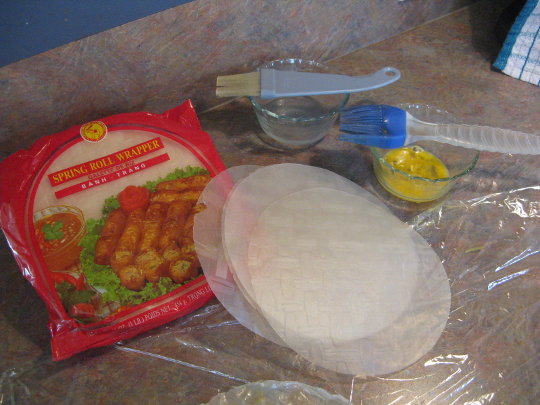
For this recipe, use the small, 6-1/2" diameter rice papers, sometimes called Spring Roll Wrappers. These rolls should be prepared no more than 4 hours ahead of cooking. Store them covered in the fridge. They can also be frozen, uncooked, for up to 2 months.

24 dried rice paper wrappers (6-1/2" diameter)
Small, rice paper (Spring Roll) wrappers...
Brush one side with water the other side with egg.
1 egg, lightly beaten
water
2 pastry brushes
oil for deep frying

Filling: 
1 Tbsp. sesame oil
6 medium, dried shiitake mushrooms
2 carrots, cut into 1/2" long julienne strips
1/2 small suey choy (Chinese cabbage), finely shredded 
1 medium onion, cut into julienne strips 
1 clove garlic, minced 
1 Tbsp. cornstarch 
3/4 tsp. Sambal Oelek, or to taste
1 egg, beaten

Dipping Sauce: 
2 Tbsp. demerara sugar
2 Tbsp. rice vinegar
2 tsp. grated fresh ginger root
1-1/2 tsp. Sambal Oelek

Place dry shiitake mushrooms in a medium bowl and cover them with hot water. Cover the bowl and set it aside for 20 minutes. When the mushrooms have softened slightly, strain the liquid through a coffee filter or several layers of cheesecloth. Reserve 2 Tbsp. mushroom liquid for later in the recipe and the rest for stock, sauces, or discard. Remove the mushroom stems and discard. Cut the caps into thin julienne strips and set aside.
Assembly Step #1
Heat sesame oil in a large skillet. Add the onion and saute until soft, add the garlic and saute until the onion is golden but don't burn the garlic. Add the julienne cut shiitake mushrooms, carrots and shredded cabbage and the 2 Tbsp. reserved mushroom liquid. Stir fry the veg over medium-high heat, just until they are still crispy. Sprinkle over the cornstarch and mix in gently. Remove the skillet from the heat, add sambals, egg and mix well. Transfer mixture to a bowl and refrigerate until cool.
Assembly Step #2
While the filling cools, make the dipping sauce. Measure all ingredients into a small glass or plastic jar with a tight fitting lid. Cover the jar, shake vigorously and set aside. 
Preheat the oil for deep frying to 350F to 375F.

To assemble the Spring Rolls: 
Step #1- cover a clean work surface with plastic wrap. Place rice paper, on the plastic wrap and brush one side lightly with water, then turn the rice paper over and brush the other side with beaten egg. Let stand just until the rice paper softens. Place one tablespoon of cooled filling on each rice paper and fold over to just cover the filling. 
Assembly Step #3
Step #2- Fold the sides in and continue to roll up snugly. 
Deep fry until lightly browned
Step #3- Continue filling and rolling until all ingredients are used. Place finished rolls between layers of plastic wrap on a bakesheet. Cover with plastic wrap and a damp, not wet, cloth. 

Deep fry in preheated oil for about 3 minutes or until lightly browned. Drain on paper towels. Serve hot with dipping sauce. 

*CHEF'S NOTE: You can prepare and deep fry these rolls up to 6 hours prior to serving. Cool completely and cover them with plastic wrap. Store in the fridge until serving time. To serve, place in a preheated 375F oven for about 8-10 minutes or until hot throughout.
 
Indonesian Spring Rolls with Dipping Sauce

Till next time Kung Hei Fat Choi and Bon Appétit!

Recipe and Photos by Sally Rae

Tuesday, December 20, 2016

Green Peppercorns ~ Poivre Vert

'Madagascar Green Peppercorns' by Moulin
'Green Peppercorns' are the unripe berries of a tropical, flowering, vine plant, Piper Nigrum. Because they are perishable, they are usually freeze dried, preserved in brine or pickled in vinegar. The harvested green peppercorns are packed in brine, vinegar, or salt soon after they're picked. They are mild and soft and can be eaten whole. In dried form, they don't last very long and must be used quickly.

They are true, unripe, black peppercorns, the same berries are processed to make black pepper. Green peppercorns have a milder, much suppressed pepper flavor but are more complex and fresh flavored than their black counterparts. In their various preserved forms, green peppercorns are popular in French, Thai, and other Southeast Asian cuisines.

Not all brands have the same quality and texture. I have found some packed in small glass jars, sold in grocery stores, that have a firm texture and unpleasant mouth feel. My preferred brand is in the photo, called 'Madagascar Green Peppercorns' by Moulin, a product of France. They are found in tins, available in 2 sizes; 71ml and 212ml. These small tins are a great stocking stuffer for foodie friends and family. They are delicious added to sauces and gravies for meatloaf, tourtierre, roast meats or turkey. To use them in my Gluten-Free Gravy recipe; after whisking in the brown rice flour and simmering for 15-20 minutes, strain the gravy, add the drained green peppercorns then serve immediately. Discard the brine -- do not cook the gravy after the green peppercorns are added.
Gluten-Free Green Peppercorn Gravy, Braised Red
  Cabbage, Steamed Broccoli, Hasselback Sweet Potato

You can find 'Madagascar Green Peppercorns by Moulin' at Runge's Imports and Delicatessen, 347-4th Street, Courtenay.  

There is no substitute for green peppercorns in brine. A substitute for dried green peppercorns are pink peppercorns which aren't true peppercorns, but they have a very mild, peppery flavor.

Till next time... thank you for your support and encouraging comments!
Season's Greetings, Merry Christmas, Happy New Year and Bon Appétit! 

Photos by Sally Rae

Saturday, December 17, 2016

Winter Veg with Fruity Vinaigrette

Another traditional side dish for the holidays is winter squash, in various preparation... baked, mashed, roasted etc. The braised recipe below with added kale, mushrooms and a fruity vinaigrette is a colorful addition for your Christmas Dinner Menu. It is a hearty, almost zero mile dish with winter squash stored from your summer garden harvest and fresh kale from the winter garden.  
As for harvesting your winter kale... the hardy leaves of kale will freeze solid in temperatures of -5C. If the leaves are frozen solid, wait until the weather has warmed up and the leaves have thawed out before you harvest. When it is safe to harvest, pick the outer leaves first. They are less hardy than the younger leaves in the center of the plant.

For variety of the fruit vinaigrette, there are a few local Oil and Vinegar Tasting rooms in the Comox Valley. If you have not tried this new specialty, go with a few girlfriends and guaranteed you will leave with some new favorite flavors and a few Christmas gifts for the foodies on your list. I have gathered a good selection from 'Signature Oil and Vinegar' near the new Thrifty Foods. My favorite two Olive Oils are: Butter and Whole Fruit Lemon. As for the vinegar; I can't live without Blackberry-Ginger Dark Balsamic, and the White Balsamic Cranberry Pear and White Balsamic Coconut are good enough to drink! The helpful staff will guide you through tasting and choosing flavors that appeal to individual taste, usage and preference. I started with 8 different flavors in 60ml bottles and graduated to purchasing the 200ml size of my favorites. 
'Signature Oil and Vinegar' is now located in the Crown Isle Shopping Centre at 207B - 444 Lerwick Road Courtenay and Tyee Plaza, Shoppers Row in Campbell River.
My current collection from 'Signature Oil and Vinegar'
WINTER VEG WITH FRUITY VINAIGRETTE       Yield: 3-4 servings 
There is a wide variety of fruit infused vinegar and oils available. Substitute your favorites in the vinaigrette.
The Fruity Vinaigrette:
2 1/2 Tbsp. seedless raspberry or blackberry jam
2 Tbsp. Raspberry or Blackberry-Ginger Dark Balsamic vinegar (or red wine vinegar)
2 tsp. Dijon mustard
2-3 Tbsp. Whole Fruit Lemon Olive Oil (or extra-virgin olive oil)
1/4 tsp. granulated garlic
Sea salt
Freshly ground pepper

Whisk together the jam, vinegar and mustard until smooth. Add olive oil, garlic, salt and pepper, whisk again. Taste and adjust seasoning. Refrigerate in a jar, stir before using. This can be made a few days ahead of time.

The Veg:
6 large, organic, crimini mushrooms -cleaned and cut into chunks
1 medium white onion -large dice
3-4 Tbsp. butter or Butter Olive Oil (or extra-virgin olive oil) -divided
3 cups peeled -cubed Ambercup or Buttercup squash
A bunch of fresh garden kale
1/2 cup whole, roasted pecans

Strip the kale leaves off the stems and slice into strips about 1/2 inch wide, set aside. Chop the kale stems into 1/2 inch long bits, keep separate from the leaves.
In a medium sauté pan, melt half of the butter, add diced onion and mushrooms. Sauté over medium heat until lightly browned, remove from the pan and set aside. 

Melt the remaining butter in the pan and add the squash cubes and kale stems. Quickly brown the squash lightly, turn the heat to medium/low, add the kale leaves, cover the pan and braise for about 8 minutes or until the squash is cooked through but not mushy. Check it every few minutes. Add the cooked mushroom mixture and drizzle with about half to two thirds of the vinaigrette. Mix and taste, add more dressing for desired flavor. Serve the remaining vinaigrette on the side. Sprinkle with pecans. Serve warm immediately. 

Till next time... Bon Appétit!

Recipe and Photo by Sally Rae