Showing posts with label Knife Skills. Show all posts

Friday, June 17, 2022

Mmmmango Season!

Ataulfo Mangoes at different degrees of ripeness
Marvelous mangoes are nearing the end of their season and can be found at good prices by the case. I prefer the Ataulfo mango, slightly smaller fruit with a flat stone and buttery, sweet, smooth flesh. For information and a cutting demo with photos, check out my Featured Post ... "Exotic Ataulfo Mangoes" from April 2016.

Easy dicing method

Don't worry about having too many mangoes ripening at once. When they are on sale, I always purchase different degrees of ripeness and more than I can use fresh. I love having a bag of diced, frozen Ataulfo Mango in my freezer for that quick mango 'fix' or new found recipe. 

To freeze mango; line a bake sheet with parchment paper or plastic wrap. Then follow the preparation and dicing methods in my previous Blog Post, Exotic Ataulfo Mangoes. Spread out the diced mango on the bake sheet so they are in a single layer and will freeze in individual cubes. When fully frozen, peel mango off of the parchment paper, break apart if necessary and move to a zip type freezer bag. The majority of the frozen fruit should be individual cubes, not a frozen lump. I have purchased frozen mango in the past and was so disappointed with the flavor and quality of the fruit that once was enough. Now every year I get a few cases of the Ataulfo Mangoes when in season, on sale and I know I have a high quality product on hand.

Below is a refreshing, fast, super delicious, gluten-free, vegetarian recipe with quinoa (pronounced keen-waa) and mango... fresh mango is best but if you have frozen to use up, just defrost it first so it does not make the dish too watery. 

'Quinoa' is a good source of plant protein and fiber. It is a gluten-free, whole grain carbohydrate, as well as a whole protein, meaning it contains all nine essential amino acids. It is light and fluffy in texture but has the 'whole grain' ability to fill you up.

CURRIED QUIONA WITH MANGO       Yield: 6 cups
Served as a side, light lunch, in a wrap or lettuce cups ... fast and refreshing!

1 cup quinoa
2 cups water
2 Tbsp. dry minced onion
1 Tbsp. chicken bouillon powder 
Cool quinoa and gently toss with remaining ingredients

2 tsp. Madras curry powder
1/2-3/4 tsp. sea salt
1/4 tsp. turmeric
 
Dressing:
2 Tbsp. avocado oil
1 Tbsp. white wine vinegar
3/4 tsp. Madras curry powder
1/8 tsp. dry mustard
sea salt and freshly ground pepper

Assembly:
1 cup diced Ataulfo mango
1 cup diced English cucumber
1/4 cup sliced green onions
2 cups mixed mesclun greens
6-8 gluten-free wraps or lettuce cups, optional

Rinse quinoa with cold water to remove the bitter tasting compound that coats the tiny seeds, place in a medium pot with water, dry onion, chicken bouillon, curry powder, sea salt and turmeric. Place over medium heat, bring to a boil. Turn the heat to low, cover and gently simmer for 15 minutes. Remove from the heat and fluff with a fork, cover and let sit another 2-5 minutes. Transfer to a medium bowl and spread out to cool.

Meanwhile make the dressing: whisk the oil, wine vinegar, curry powder and dry mustard in a small bowl to blend. Season dressing with salt and pepper to taste.

Curried Quinoa Wraps
Assemble the salad: to the cooled quinoa add the diced mango, cucumber, green onions and dressing. Gently toss to coat.

Serve as a side dish or for a light lunch serve on a bed of mesclun greens or with lettuce cups. For wraps: divide the greens between 6-8 wraps, spoon the quinoa mixture and wrap firmly closing one or both ends.

Until next time ... Bon Appétit!

Recipe by Sally Rae
Photos by Sally Rae

Sunday, April 29, 2018

Whole30 ~ For The Health Of It

I recently had a consultation with a Functional Medicine Practitioner. My personalized prescription started with a Paleo style, whole organic foods, AIP (Autoimmune Protocol) diet. For 30 days, the guidelines followed are easily found through "Whole30". I learned how some of my favorite foods are having a negative impact; creating chronic inflammation, low energy levels, digestive issues and chronic pain without even realizing it.
 
This protocol does require effort; grocery shopping, meal planning, dining out, discipline ... it comes down to taking responsibility for your plan and learning to say 'No, thank you'. YOU make the choice to eat something healthy, to commit 100% for the full 30 days. *"The plan eliminates the most common craving-inducing, inflammatory, blood-sugar disrupting, gut damaging food groups for a full month. The 30 days are required to break bad habits and stop unhealthy cravings ... to let your body heal and recover from whatever effects those foods may be causing ... and push the reset button with your health, habits and relationship with food."

Whole30 compliant
Read Labels!! 
I was shocked to find hidden sugar, sulphites and grains in many of my favorite condiments. My pantry is now re-stocked and Whole30 compliant with ... Spectrum Organic Balsamic Vinegar of Modena (natural occurring sulphites is Whole30 compliant), Red Boat Fish Sauce (no sugar, just anchovies and salt), Coconut Aminos to replace soy sauce, Maison Orphée Organic Raw Dijon Mustard, Primal Kitchen Real Mayonnaise with avocado oil, organic coconut milk and cream and Chosen Foods cold pressed naturally refined Avocado Oil for all cooking and high heat applications. Avocado oil has health benefits similar to olive oil, and a high smoke point (260̊ C or 500̊ F). At its smoke point, an oil begins to break down producing toxins and trans fats that can have a foul odor and taste and are toxic to our body.

For years I have not eaten nightshades; potatoes, tomatoes, eggplant and peppers, they trigger my arthritis. With recent health concerns, I have been eating a totally grain free diet since May 2017, no grain of any kind including all rice and corn. The Whole30 plan has also eliminated all dairy, sugar (including stevia, a bit shocking but I now understand WHY), legumes, alcohol, carrageenan, MSG, sulphites, baking, junk food and treats. There are a few exceptions to the rule, so it's best to check out the Whole30 site. I found their 'tough love' section very helpful. *"It's not hard" ... *"It's only 30 days and it's for the most important health cause on earth--the only physical body you will ever have in this lifetime."

The recipe below started out with a need for something I could have on hand for any meal of the day and take on the ferry for a quick, healthy snack or lunch. It has morphed into one of my favorite foods; crunchy yet creamy, filling and healthy, with options to make it into a complete meal by adding olives, avocado slices or hard boiled eggs. 
I hope you enjoy it as much as I do!

Kale Salad with Avocado/Lemon Dressing   Yield: 4-6 servings 
Crunchy yet creamy, even on the third day in the fridge! Turn this salad into a more complete meal by adding olives, avocado slices and/or sliced hard boiled egg.

1/2 bunch organic kale; washed, dried, stems removed and thinly julienne sliced 
1 Tbsp. fresh squeezed organic lemon juice 
Mise en place
1 Tbsp. organic extra virgin olive oil 
6 small leaves Chinese cabbage, thinly sliced 
3 large organic mushrooms, halved and sliced 
1/2 small organic zucchini, halved lengthwise and sliced 
2 stalks organic celery, sliced on the bias (diagonal cut) 
3 organic green onions, sliced on the bias (diagonal cut) 
~Serve with olives, sliced avocado and/or sliced hardboiled egg, optional  

Wash and dry the kale, remove and compost heavy stems, julienne slice leaves thinly. Place in a large bowl with 1 Tbsp. each lemon juice and olive oil. Massage the kale until softened. Set aside and make the dressing.

Avocado/Lemon Dressing
 
Avocado/Lemon Dressing
3 Tbsp. fresh squeezed organic lemon juice
1/3 cup organic extra virgin olive oil  
1 large or 1-1/2 small, ripe avocados  
1 tsp. organic Dijon mustard  
4 cloves organic garlic, minced  
1/2 tsp. sea salt  
1/4 tsp. freshly ground pepper 

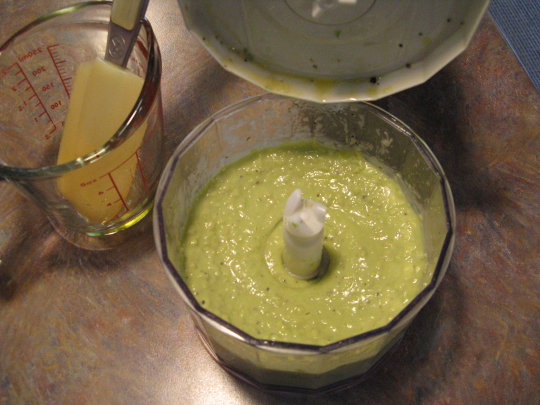
To make the dressing; in a small food processor, combine all dressing ingredients until smooth, set aside. 

For the salad; wash, trim and cut all remaining vegetables, add to softened kale and toss to combine. The dressing will be thick, spoon over salad and 'rub' into ingredients with a silicone spatula or the back of a spoon. Continue to rub and fold the dressing into the salad until combined. 
For a more complete meal, serve with olives, sliced avocados and/or hardboiled eggs.
Healthy, delicious and Whole30 compliant!
Till next time ... in good health and Bon Appétit!


Recipe by Sally Rae
Photos by Sally Rae
*Some Information above has been gathered through Whole30

Wednesday, March 8, 2017

Hand Pulled Noodles

I love noodles! A Google search proves there are many different methods and styles of pulling Asian noodles. When the opportunity arose for me to watch and learn, one-on-one, how to 'hand pull noodles', I jumped at it!! 

I was honored to meet a mother and daughter from TAIYUAN, in Northern China. These noodles are a common meal in their home, to me it's an incredible culinary art. I was thrilled to watch, practice and ask questions in person, first hand... an opportunity of a lifetime for me! 
Roll, rest and ready to start
Cut, keeping one end intact

The dough, made from a special high gluten flour, water and salt, takes time to knead and rest so was already prepared and ready to roll and cut. We were told the knife they use is twice the size we had available and the board they use is four times the size of ours, so she had to compromise and downsize her method.

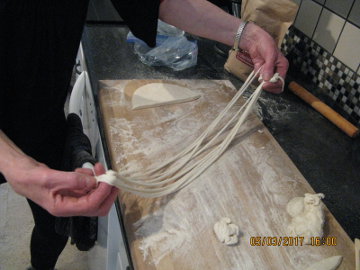
The soft, supple dough was rolled with a special wooden rolling pin. The end cut was removed and set aside. Then noodle cuts were made, keeping one end intact. I was instructed, (and did not perfect) a quick, strong, flick of the knife blade at the end of each cut. This flick turned the cut edge of the dough upwards, so it could be floured and the noodles would not stick together. Once the strips were cut and floured, they were rolled over each other into a rope. Wrists are crossed so when the rope is picked up it is twisted again. 

It was amazing how strong the dough was, yet soft and pliable. Once the rolled rope is picked up and twisted, it is gently stretched while pounding on the floured board. I was timid to break the noodles but was assisted to spread my arms further apart to stretch the dough thinner. As I became more confident, the noodles were doubled over and then pulled and pounded more.

A wok of boiling water was kept on the stove. Once pulled and ready, the noodles were immediately lowered into the boiling water. The connected end of dough was pinched off at this point. Once in the boiling water, the noodles were stirred with chop sticks. When the noodles were floating near the top of the boiling water, they were ready to be removed and served fresh and hot.
The left over, made into 'cats ears'

Into the wok
The left over 'scraps' of dough were not wasted. They were gathered together and gently kneaded. Then cut into small pieces and rolled under the thumb almost like a tiny gnocchi. They translate to 'cats ears', and were also cooked in boiling water until they float. Then served with the same toppings.

Before the noodles were made, two toppings had been prepared; one of egg and tomato, slightly sweetened with sugar, and a stir fry of prawns, mushrooms, potato, red onion, broccoli, cabbage, tofu and a special sauce brought from China, that had a kick of heat. As the noodles were ready, they were portioned into bowls, topped with the sauces and enjoyed by all of us. By that time I was so interested in eating, I forgot to take photos!! The noodles had a chewy, substantial texture and the topping accompaniments, fresh, flavorful and delicious.
Several days later, I still reflect on this incredible experience and hope to make an attempt to replicate it at home.

Till next time... Bon Appétit!

Photos by Sally Rae

Sunday, December 11, 2016

Hasselback Sweet Potatoes

Sweet Potatoes are a traditional side dish for Thanksgiving and Christmas. In a previous Blog, 'Sweet Potato or Yam?', I wrote about the different colors of these tubers and history of the term 'yam'. I have added a new 'Label' for 'Sweet Potato' to my Blog. Click on the label for a quick reference... from recipes all the way to DIY slips and information on growing them.

Hasselback potatoes are commonly prepared using white fleshed potatoes. For anyone avoiding the nightshade family this is a delicious substitute. You may even find you prefer this easy, sweet and crispy version instead!

Use 2 wooden spoon handles

Use the dark orange flesh variety of sweet potato. They remain moist and sweet when baked. 
If you are not confident in your knife skills, use either two chop sticks or the handles of two wooden spoons to prevent slicing completely through. I have heard specialty kitchen shops sell a gadget for cutting hasselback potatoes but these methods will work just fine. 

HASSELBACK SWEET POTATOES
Sweet and moist on the inside and crispy on the outside. These sweet potatoes are the perfect side to serve at any festive occasion!

4 medium sweet potatoes
1-1/2 Tbsp. unsalted butter, melted
2 tsp. olive oil
1 tsp. minced fresh thyme 
1/2 tsp. granulated garlic
1/4 tsp. sea salt

1/4 tsp. freshly ground black pepper 
 
Preheat the oven to 425 F. Line a baking sheet with aluminum foil. Make a series of 1/8-inch slices along each potato, slicing 2/3 of the way through. (*See notes above using wooden spoon handles or chop sticks as a guide.)
Stir together the melted butter, oil, thyme, garlic, salt and pepper in a small bowl. Rub the potatoes all over with the mixture, getting in between the slices.
Place on the baking sheet and roast until the center of the potatoes are tender and the outside is crisp, 50 minutes to 1 hour. 

Halfway through the roasting time, remove the potatoes from the oven and run a fork gently across the tops of the potatoes, using light pressure, to fan the slices and separate them from one another. 

Till next time... Bon Appétit!


Roasted Hasselback Sweet Potato

Photos and Recipe by Sally Rae 

Tuesday, April 5, 2016

Exotic Ataulfo Mangoes

Tommy Atkins and Ataulfo Mangoes
There are hundreds of mango varieties but only about 4 or 5 varieties are common in our local marketplace. My hands down favorite is the 'Ataulfo Mango'. Primarily grown in Mexico with peak season being mid-March to early June. Usually smaller than most varieties and sometimes more expensive but the only mango that consistently impresses me with their texture and flavor.

Ataulfos are small with an oval, flattened shape and are fully ripe when the skin turns a deep golden color with small wrinkles.
Note size of seed @ bottom; Tommy Atkins left ~ Ataulfo right

 
The flesh is vibrant yellow and has a creamy, sweet flavor. They have a very small seed so there is a high flesh to seed ratio. The flesh is smooth and firm with no fibers which makes them my first choice. Besides the color and wrinkles, another test of ripeness of the Ataulfo is that it will give slightly to a gentle squeeze. Use your experience with peaches and avocados which also become softer as they ripen. 
NOTE: the red color on some mango varieties is not an indicator of ripeness. Always judge by feel.

For the past few weeks, Thrifty Foods has featured Ataulfo Mangoes on sale at a great price. I took the opportunity to stock up, purchasing different degrees of ripeness. Unripe mangoes should be stored at room temperature. This way they will continue to ripen becoming softer and sweeter over several days. To speed up ripening, place in a paper bag at room temperature. Purchasing a few ripe, ready to eat and some still green, extends your eating enjoyment.
Ataulfo Mangoes at different degrees of ripeness
Once ripe, move to the fridge (if they last that long!) to slow down the ripening process. Whole, ripe mangoes can be stored in the fridge for up to 5 days. They can be peeled, cubed and placed in an airtight container in the fridge for several days or frozen for up to 6 months.

Mangoes have one long, flat seed in the center of the fruit. Once you learn how to work around the seed the rest is easy. Always wash mangoes before cutting. Stand the mango, stem end down on a cutting board and hold. Place your knife about 1/4" from the widest center line and cut down. Flip the mango and repeat for the other side. The resulting ovals of flesh are called 'cheeks' and what is left in the middle is mostly the mango seed. 

To slice; cut parallel slices into the mango flesh being careful not to cut through the skin. Then 'scoop' the sliced flesh out of the skin with a large spoon. Slices can be cut thick or thin as desired.

To dice; cut parallel slices into the mango flesh being careful not to cut through the skin, as for slicing. Turn the mango cheek 1/4 rotation and cut another set of parallel slices to make a checkerboard pattern. 

Now you have two choices; either 'scoop' the diced flesh out of the skin with a large spoon or turn the scored mango cheek 'inside out' by pushing the skin up from underneath and scrape the chunks off the skin with a knife or spoon.

Chef's Tip: if your recipe calls for diced mango, make your parallel slices closer together. The result is small pieces of diced mango and no need to further cut up on your board.

There is a gadget available called a Mango Slicer. The instructions read, '...simply place mango in the holder and press cutter to remove the pit.' Like many other kitchen gadgets, I have never tried these... I am more comfortable with the control of a knife and cutting board. It is a matter of comfort and preference.

Mangoes are a healthy snack for any time of day. Add frozen, diced mango to your morning smoothie or stir fresh mango cubes into plain yogurt with a drizzle of honey. Make ice pops by freezing mango puree in ice cube trays with a popsicle stick. Toss chunks into a fruit salad or add to a green salad. Elevate desserts, use fresh slices to decorate and garnish exotic 'Coconut Panna Cotta', check out my May 2015 recipe and post  'Simple, Sexy Panna Cotta'.

These methods can be used for all varieties of mangoes. Although in my opinion, the Ataulfo Mango is far superior in texture and flavor to other varieties I have tried. Therefore the Ataulfo wins as my hands down favorite!

Till next time... Bon Appétit! 

Photos and demo by Sally Rae